Datasheet
Servoplan E 600
Fast setting, curing flowable screed
- self-levelling
- quick-setting and quick-drying
- can be covered very early with ceramic tiles
- very low tension
- can be pumped
- from 5 - 80 mm layer thickness
- suitable for underfloor heating
- for many thin underfloor heating systems
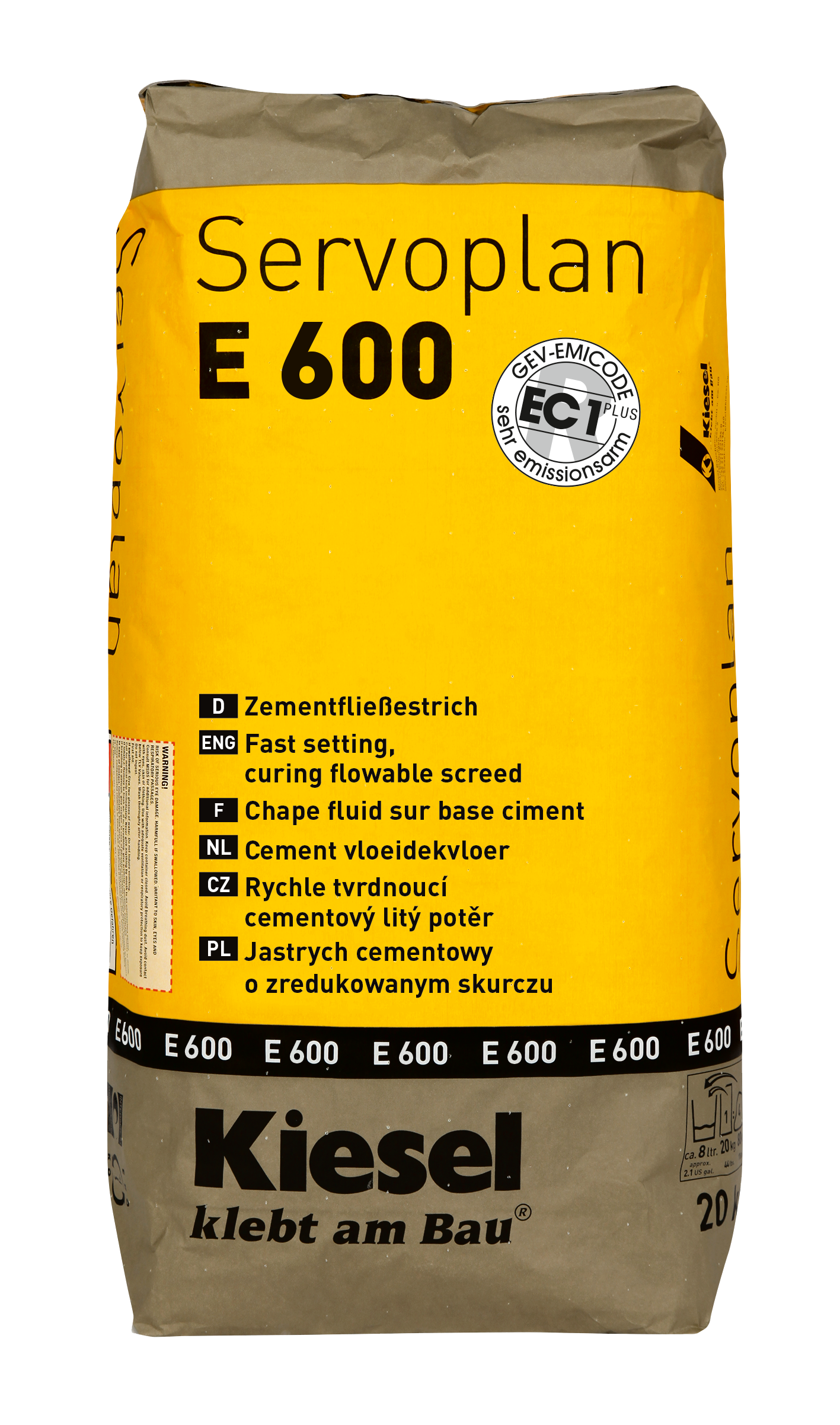


Cement-bound, polymer-modified, fast-setting flowing screed ready-mixed mortar in accordance with DIN EN 13813 for the production of cement flowing screeds that can be covered early in accordance with DIN 18560. Strength class CT-C40-F7 in accordance with DIN EN 13813. For the production of bonded screeds, screeds on separating and insulating layers and as heated screeds on insulating layers, depending on the respective layer thickness in areas of utilisation categories A, B, C 1-3, 5, D1-2, E1, T1-2 and Z, in accordance with DIN EN 1991-1-1/NA:2010-12.
Servoplan E 600 is suitable as a substrate for laying ceramic coverings, natural stone, artificial stone in bonded execution. Suitable as an unbonded screed on a separating layer, floating screed and heated screed under resilient and textile floor coverings and parquet. Suitable for dry interior areas on load-bearing, rigid and dimensionally stable substrates, and for water exposure classes according to DIN 18534 W0-I and W1-I in private bathrooms and hotel showers – in conjunction with a bonded waterproofing system. The general guidelines for cement screeds DIN 18560 apply to working with the product.
For floating screed or screed laid on a separating layer, the readiness for covering when laying vapour-proof coverings and parquet without underfloor heating is <= 3.0 CM-%, with underfloor heating <= 2.5 CM-%. For KRL measurement 75 % relative humidity with heated screeds and 80 % relative humidity unheated.
Please observe all relevant standards, regulations and trade rules, especially DIN 18353 and DIN 18560, Part 4. Provide and install expansion joints as for conventional cement screeds. Dummy joints must be cut after 48 hours at the latest. The substrates must be clean, dry, solid, dimensionally stable and free of adhesion-reducing residues. Suitable and appropriately dimensioned edge insulation strips must be attached to rising building components, in order to prevent clamping. The separating layers must be laid without folds so that the fresh mortar does not leak into the insulation or neighbouring components; if necessary, the joints of the foil must be glued.
The size of the work surfaces must be determined in such a way that they can be completed within the processing time. Larger areas must be interrupted accordingly with screed angles, expansion joint profiles, etc. Compact surfaces with an aspect ratio of 1:1 or 1:2 are preferable.
Areas up to max. 6.5 m side length and max. 40 m² area size are possible as heated screeds. The pipe overlap for hot water underfloor heating must be at least 35 mm. A maximum flow temperature of 55 °C is possible. Before covering with top layer, functional heating must always be carried out and recorded in accordance with DIN EN 1264-4 and interface coordination for heated floor designs. The first heat-up should begin at the earliest 24 hours after screed installation with a flow temperature of 25 °C; this must be maintained for 3 days. The maximum flow temperature is then set and maintained for a further 4 days. The surface temperature (≥ 15 °C to approx. 20 °C, depending on the surface covering to be laid) is then adjusted during processing. Otherwise, continue heating until the floor is ready for covering.
For unheated areas, a maximum side length of 8 m and an area of up to approx. 60 m² are possible. The base areas may have a maximum aspect ratio of 1:2.
When used bonded in combination with the substrate, prime the substrate with e.g. Okatmos® DSG, Okatmos® GG, Okapox GF, Okamul PU-V schnell, Okatmos® UG 30 or Okatmos® EG 20. It must be ensured that an effective seal against rising moisture is guaranteed on components in contact with the ground and substrates that are still damp (e.g. concrete ceilings). Moisture-sensitive substrates – such as calcium sulphate screeds – must be protected from moisture from the mixing water by suitable measures. Prime calcium sulphate screeds with layer thicknesses > 10 mm with Okatmos® DSG, Okamul PU-V schnell or Okapox GF. A system structure must be ensured. Only work on mastic asphalt screeds on a separating layer.
Mix Servoplan E 600 with clean water using a suitable mixer at approx. 600 rpm until lump-free, stir again after the maturing time. For larger surface areas, Servoplan E 600 can also be applied by machine (e.g. M-Tec duo-mix 2000, Putzmeister ...). The fresh mortar should be spread over the properly prepared substrates at the specified height and worked over with a buffing rod or smoothing trowel. When using pumping technology, the flow dimension must always be checked.
During (and after) application, the surfaces must be protected from draughts, sunlight and strong heat for 24 hours. The screed thickness must be selected in accordance with DIN 18560 depending on the expected load and the selected type of construction.
Only C2-S1 installation materials can be used for laying ceramic/natural stone coverings.
COVERING LAYERING for BONDED versions ≥ 5 mm to 80 mm layer thickness:
| For tile laying: | after approx. 3 hours |
| When laying natural stone: | after approx. 24 hours / 10 mm layer thickness |
| For floor covering installation: | after approx. 24 hours / 10 mm layer thickness after approx. 48 hours / up to 20 mm layer thickness after approx. 72 hours / over 20 mm layer thickness |
| For parquet installation: | after approx. 72 hours |
TOP COVERING LAYER (no tiles, natural or artificial stone coverings) when applied as a rapid screed on a SEPARATING or INSULATING LAYER in accordance with DIN 18560 ≥ 30 mm or 35 mm layer thickness.
According to DIN 18560 T4, the separating layer for cement screeds must generally be 2-layered.
For flooring and parquet installation:
Check that the screed is ready for covering after approx. 7 days by measuring the CM-% or KRL %. Once the screed is ready for covering, immediately cover it with the intended floor covering after priming and levelling if necessary.
COVERING INSTALLATION when designed as a rapid screed on INSULATING LAYER WITH HOT WATER FLOOR HEATING in accordance with DIN 18560 ≥ 35 mm pipe cover
Functional heating begins at the earliest 24 hours after screed installation with a flow temperature of 25 °C; this must be maintained for 3 days. A flow temperature of 55 °C should then be set and maintained for a further 4 days. The surface temperature ≥ 15 °C to approx. 20 °C, depending on the surface covering to be laid) should then be set during application.
For flooring and parquet installation:
Set the surface temperature to 20 °C after functional heating is complete. Then immediately cover the screed surface with the intended floor covering after priming and levelling if necessary.
COVERING INSTALLATION with only 20 mm or 25 mm layer thickness when using the KIESEL ECO SOUND SYSTEM.
For floor covering installation:
The screed surface must be sealed immediately after approx. 24 hours with Okatmos® DSG in two coats and then levelled and covered immediately.
For parquet laying:
The screed surface must be sealed with Okamul PU-V schnell in two coats after approx. 24 hours and covered within 48 hours.
Color
grey
Application
indoors, on floor surfaces
Application temperature
+5 °C (41 °F) to +25 °C (substrate) (41 °F to 77 °F)
Water demand
approx. 3.2 - 3.4 litres / 20 kg powder
Processing time*
approx. 60 minutes
Thickness
bonded: 5 - 80 mm
on separating layer: 30 - 80 mm, 20 mm with Kiesel Ki 881 Eco Sound Mesh
on insulation layer: 35 - 80 mm
on Kiesel Ki 880 Eco Sound deadening track: at least 25 mm
bonded: after approx. 3 hours
on separating layer: after approx. 3 - 6 hours
on insulation layer: after approx. 3 - 6 hours
| for screed on separating layer and on insulation | |
|---|---|
| Resilient coverings: | after approx. 7 days / CM-/KRL- measurement |
| Textile coverings: | after approx. 7 days / CM-/KRL- measurement |
| Parquet: | after approx. 7 days / CM-/KRL- measurement |
for bonded implementation with the substrate | |
|---|---|
| Ceramic coverings: | after approx. 3 hours or after walking capacity |
| Natural stone: | after approx. 24 hours / 10 mm layer thickness |
| Floor coverings: | after approx. 24 hours / up to 10 mm layer thickness |
| after approx. 48 hours / up to 20 mm layer thickness | |
| after approx. 72 hours / over 20 mm layer thickness | |
| Parquet: | after approx. 72 hours |
Fire classification
A1fl according to DIN EN 13501-1
suitable (please see instructions)
ZP 1 - low-chromate after TRGS 613
EMICODE®
EC 1Plus in accordance with GEV
store in a dry place; can be stored for approx. 6 months
*
At 68 °F (+20 °C) and 65 % relative humidity. Higher temperature and low humidity decrease, lower temperature and high humidity increase this value respectively.
Higher water additions and an unfavourable construction site climate can lead to higher shrinkage behaviour and/or cracks or cupping of the load distribution layer. Building joints should be adopted on principle.
The specified times for covering will depend on the building climate conditions and the applied layer thicknesses, and, therefore, serve as reference values.
Given that mineral building materials interact physically with their environment, the screed surface must be covered immediately after it is ready for covering. Otherwise, post-treatment will be required, e.g. covering with foil or priming with Okatmos® DSG and with Okamul PU-V schnell for the direct gluing of parquet. Only use material from the same batch.
For information on Eco Sound System, please refer to the respective data sheets.
approx. 1, 8 kg/m² per 1 mm thickness
approx. 56 ft² per bag
Clean tools and machines immediately with water. If work is interrupted, the mixers and hoses must be cleaned immediately.
| Product description | Item no. | Item no. |
|---|---|---|
| 54 x 20 kg paper bags | 42053 | 4015705420530 |
The aforementioned information, especially the proposals for processing and utilizing our product, is based on our knowledge and experience. We recommend that you carry out your own tests in every case to ensure the suitability of our products for the intended process and processing purposes because of the different materials and the working conditions which lie beyond our area of influence. No liability can be derived from this advice or from verbal advice, unless we are responsible for (criminal) intent or gross negligence in this respect.
Revised: 09.04.2024/ag