Datasheet
Kiesel Alumino-Silicate glass fiber mesh
Special Alumino-Silicate glass fiber mesh reinforcement for Okapox GF
- for the proper binding and structural reinforcement of non-absorbent or absorbent substrates
- in order to reduce cracking from the substrate
- additional reinforcement of various substrates to prevent transmission of damaging shrinkage and stress cracks from the subsurface
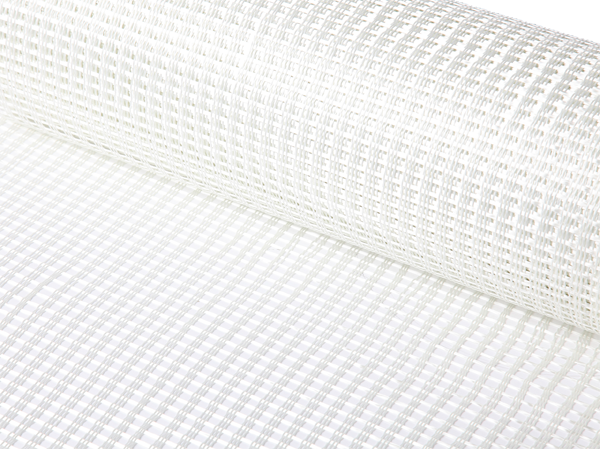
The special Alumino-Silicate glass fiber mesh is used for the proper binding and structural reinforcement of non-absorbent or absorbent substrates for pre installation of tiles and other covering materials over concrete surfaces and other approved substrates.
The silica glass fiber mesh incorporates epoxy primer Okapox GF and is used as additional reinforcement of various substrates to prevent transmission of damaging shrinkage and stress cracks from the subsurface.
Fiber mesh and the epoxy coating acts as an extremely heavy duty anti- fracture membrane eliminating penetration of stress in to the tiles or other covering materials.
The silica glass fiber mesh combined with Okapox GF provides an additional moisture barrier.
Contact the Kiesel technical department when installing different materials/coverings then ServoArt® CeFlo.
The substrate must be tested and ready for installation in accordance with VOB part C, DIN 18 352, DIN 18 356 and 18 365 as well as the art. Pre-treat substrates according to the current BEB publication "Assessment and preparation of substrates" and the TKB-8 in the current version.
Install movement and expansion joints prior to installation. Install a seal gasket around the installation area and its perimeter (keep in mind different obstacles and use a seal gasket around them). Same installation method of the seal gasket is required when installing over non-rigid soft and floating substrates.
Then, roll out the silica glass fiber mesh over designated substrate without any wrinkles. Use micro serrated scissors or a so-called EC-Cutter to cut silica glass fiber mesh. The silica glass fiber mesh should be overlapped by at least 5 cm. Always overlap and install silica glass fiber mesh in one direction.
Mix Okapox GF according to a separate technical data sheet. Then pour Okapox GF in designated area and spread with a flat trowel without moving or wrinkling fibre mesh. Wait until fibre mesh is completely saturated and remove the excess of Okapox GF if necessary. Avoid creating puddles. Let the Okapox GF and fiber mesh completely dry. Should you encounter any imperfections after the proper drying and curing, grind the designated areas down and recoat with Okapox GF.
After the proper curing and drying time, but before first 48 hours from the initial installation; prime the surface of Okapox GF and fiber mesh with Okatmos® EG 20 or Okatmos® UG 30.
Do not cover existing structural joints which separate individual parts of the building from structural and physical reasons. Same principal applies to expansion or cold joints.
Color
white
25 m / 50 m
1,03 ± 1 %
Glowing loss
0,8 %
Absorption of water
< 0,1 %
Softening temperature
860 °C
Fire resistant
not flammable
Material
Alumino-Silicate glass fiber mesh, according to DIN EN 1259-1
Nett weight
approx. ca. 270 g/m²
Bulk density
2,58 g/cm³
Elastic modulus
approx. 70.000 N/mm²
Tensile strength
approx. 3.500 N/5 cm
Application
only with Okapox GF
Approx. 800-950 g/m² of Okapox GF. As moisture barrier approx. 500 g/m².
| Product description | Item no. | Item no. |
|---|---|---|
| Rolls with 25 m length packed in a single carton | 15062 | 4015705150628 |
| Rolls with 50 m length packed in a single carton | 15042 | 4015705150420 |
| Palletizing: 20 rolls of 25 m / 12 rolls of 50 m² on Euro pallet |
The aforementioned information, especially the proposals for processing and utilizing our product, is based on our knowledge and experience. We recommend that you carry out your own tests in every case to ensure the suitability of our products for the intended process and processing purposes because of the different materials and the working conditions which lie beyond our area of influence. No liability can be derived from this advice or from verbal advice, unless we are responsible for (criminal) intent or gross negligence in this respect.
Revised: 01.08.2014/lo